

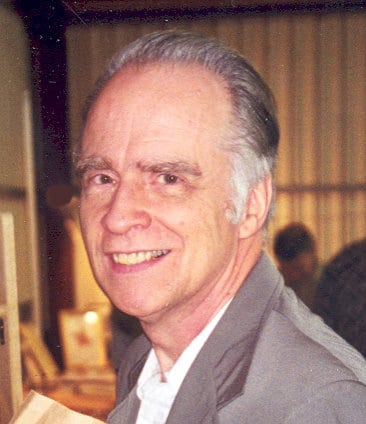
We of the Flag Heritage Foundation mourn the passing of David F. Phillips, our Series Editor, fellow Trustee, and friend. David Frank Phillips II (his full name, which he rarely used) was born September 15, 1944. He passed away on March 26, 2020 from a confluence of health issues.
David, for us, had two impressive personas. The first was David as a longtime member of the Board of Trustees. In this role he was a constant initiator. He was always full of proposals to pursue book projects, to make the most of our collections, to find the best professionals to support our work, and in general to lead us forward. He was equally adept as an editor, as a researcher, and as a writer. His sense of organization was consonant with his background in law and librarianship. He worked very smoothly with the others of us on the Board of Trustees, bringing to us project proposals that were so fully developed that our unanimous endorsement was always a formality. Although his first love was heraldry, he drew respect as a scholar in vexillology as well. All his work was to a very high standard. One could see David as a formidable combination of scholar, editor, and administrator.
Those coming to know David only through the Foundation, however, would begin to realize that David’s true scope was much broader, amounting to quite a different persona. “David wins, hands down, the Reader’s Digest prize for ’The World’s Most Unforgettable Person,’” one of his friends remarked on learning of David’s death. His legal career ranged from defender of Timothy Leary to law librarian. His writing led beyond scholarship to poetry, children’s stories, travelogues, essays, biography, and autobiography. Earlier he had been a draft counselor at the time of the Vietnam War, a taxi driver, a typist, a radio and television broadcaster, and an English teacher in Taiwan. He was one of America’s foremost collectors of heraldic books, atlases, first-day covers, and works in sundry other categories. His spiritual explorations were informed by early psychedelic experiences, which led him eventually to Buddhism and veneration of the Hindu god Ganesha. And even this list is merely suggestive of the twists and turns of his personal journey, as recounted in his autobiography.
David will be sorely missed by his family, colleagues, friends, and acquaintances, and in particular by the remaining Trustees of the Flag Heritage Foundation. He leaves siblings Christopher, Adam, and Victoria, as well as a niece and a nephew.
Some life details: David grew up in Manhattan. He graduated from Columbia University in 1968 and the University of Pennsylvania Law School in 1971. In 1974 he added an M.S. from the Columbia School of Library Service, leading later in his career to his contributions as a legal librarian. For many decades he made his home in San Francisco, where he resided at the time of his death.
Publications: David’s own publications include, as author, “Emblems of the Indian States” (2011) and “The Double Eagle” (2014), and as editor and lead contributor, “Japanese Heraldry and Heraldic Flags” (2018). All three appear in the publication series of the Flag Heritage Foundation and are available on Amazon. David was a frequent contributor to the British journal The Heraldic Craftsman and was one of only two writers granted craft membership in the Society of Heraldic Arts, in England. At the time of his death he had completed the manuscript and design for a book about the heraldic work of the Polish-born artist Arthur Szyk. Most recently, he was the editor and compiler of “Psychedelic Refugee,” the memoirs of Rosemary Woodruff Leary (Timothy’s wife), to be published next winter by Inner Traditions.
Web site: David’s website Radbash.com contains his extensive autobiography, a full list of his heraldic and other publications, and his essays on many other topics ranging from Buddhism to how he became entranced by heraldry as a young child. In a way, David considered this website to be a summation of his life and of his incredibly wide-ranging and original thought.
Our heartfelt thanks to David’s brother Christopher Phillips for essential contributions to this narrative of David’s life and work.





 in April 2014, and is applying the proceeds of the sale to fund the Flag Heritage Fund at the University of Texas. This gift will allow the Flag Research Center’s vast collection of books, pamphlets, files, papers and documentation about flags, their history and meaning to find a permanent home at the Dolph Briscoe Center for American History at the University’s flagship campus in Austin. This collection, assembled over many decades by Dr. Whitney Smith, the foremost scholar in the field, is the greatest of its kind in the world, and we hope and expect that it will form the nucleus of a great public center for study and scholarship.


Scot Guenter (1956-2026)
The Flag Heritage Foundation mourns the passing of our Trustee, Professor Scot M. Guenter (1956-2026). He was a professor emeritus of American Studies at San José State University, where he served as coordinator of the American Studies Program and director of the Campus Reading Program.
“Keep studying those flags!” These are the words that we heard from Scot whenever he gave a lecture to a group of assembled vexillologists. It wasn’t just a catch phrase, but rather a reminder of the core task for any serious flag scholar. Scot understood that flags are a product of human culture and that there was much that could be learned by studying them.
The list of Scot’s contributions in our field is substantial. He served as the 11th president of the North American Vexillological Association (NAVA), as a Trustee of the Flag Heritage Foundation, and as Director and Whitney Smith Principal Research Scholar for the Flag Research Center. His scholarship was highly respected earning him multiple accolades. To date, he is the only three-time winner of NAVA’s Driver Award for the best paper presented at a meeting and he was honored with a lifetime membership in the organization. He was named both a Fellow and a Laureate of the Fédération internationale des associations vexillologiques (FIAV). He was also a Fellow of the Vexillological Association of the State of Texas (VAST) and a Whitney Smith Fellow (WSF).
Scot’s research was focused on the American flag as a cultural phenomenon, but he also explored cross-cultural studies of symbols of all kinds. He was particularly interested in the study of civil religion – the examination of the symbols, rituals, and myths that are central to a country’s culture of patriotism. Whether he was discussing flag clothing and tattoos, flag houses, or social conflicts over who has the right to use the national flag and define its meaning, he challenged us to constantly reexamine the role of flags in national identity and culture. His book, The American Flag, 1777-1924: Cultural Shifts From Creation to Codification, traced the changing status of the flag in American culture and showed how the “cult of the flag” was developed and propagated by various patriotic organizations and entities. His numerous articles on the US flag and on flags as a cultural phenomenon continued this study and revealed the ever-expanding influence of the flag as an icon of American identity.
One of his most significant achievements, in terms of promoting the scholarly study of flags and symbols, was the founding of NAVA’s peer-reviewed journal – Raven: A Journal of Vexillology. In his introductory essay for the first volume, Scot explained:
For some people the line between flag-waving and flag-studying, between emotional identification and intellectual inquiry, can become a blur. True vexillologists must be aware of the power and process of patriotism and nationalism, but they will constantly remind themselves these are cultural phenomena that we are analyzing, not preaching. Reflexive awareness of one’s own enculturation is important for all who will engage in this discipline.
Over thirty years later, the journal continues to publish leading scholarship in the field, fulfilling Scot’s hopes that “this publication shall become a lasting and important source to which readers can turn to find internationally respected articles in vexillology.”
We will remember Scot as a dear friend, an observer of popular culture, and an outstanding flag scholar. He showed us many paths to examine the cultural phenomenon of patriotic symbols to see what can be learned. And he always challenged us to “Keep studying those flags”.